
I’ve been writing on this site for over a decade. Never before have I written about economic issues with the precision we will explore. Typically, I would have these conversations with buddies over scotch and cigars, or hookah. If you’re a follower of this blog, you realize that much has changed. The change occurred not just in my personal life, but, for many people. Now, with AI, change is the new normal.
The evening began with me looking over a graph that explored Disney’s financial market share in film, specifically. It covered the years from 1995 to 2025. That’s a decent chunk of data. Then, I discovered a phrase that I wanted more information regarding. That phrase was, “K-Shaped Economy.”
Now, I don’t have a degree in business or finance. In fact, I have an unfinished two year associates in “Music Performance, with an emphasis on vocal performance.” Follow that with a technical diploma in “Music Production and Recording” from a music university in Arizona. However, in my youth, I helped people.
The help I provided was due to my ability to see the world differently. I helped people in finance, law enforcement, relationships, entertainment, the military, government, etc. The list goes on. And so, tonight, while reading this graph and looking at the description about this “K-Shaped Economy” I was curious.
I believe if you follow the greats, you can forecast possible outcomes. Disney is one of the great American businesses of all time. To see the data on how Disney is slowing shifting into a luxury category was surprising. Disney has been for the masses, families, and children. It was never exclusive. This made me wonder, “If Disney is headed down a path of exclusivity with rising ticket prices, and streaming, etc… what’s the potential fall out from a K-Shaped Economy?”
And so, with Google Gemini, I started the research. Gemini and I spoke exactly as I would with former friends who enjoyed a spirited debate, cigars, and whiskey. And here, after some time this evening, is what we finally arrived it.
May you find the ideas within illuminating.

OVERVIEW:
This thread deeply analyzed the K-shaped economy, confirming its status as a major mainstream economic challenge defined by the divergence of fortunes between the thriving wealthy (Upper K) and the financially struggling low-to-middle-income workers (Lower K). The discussion established that this divergence leads to economic anemia, evidenced by surging debt and weakened consumer demand. To address this within a free-market capitalist framework, a solution was developed: companies should adopt intensive, strategic technical training. This investment, secured by non-compete agreements, fundamentally raises the value and wages of the Lower K workforce, offering companies a massive financial return via reduced turnover and increased productivity. Widespread adoption of this model promises a theoretical positive return for the American economy by boosting overall consumer demand and creating a more stable, high-skill national workforce.
MAIN POINTS:
* K-Shaped Reality Confirmed: The economic model of divergent fortunes (Upper K thriving, Lower K struggling) was established as a mainstream reality, not speculation.
* Risks Identified: Key concerns were defined, including suppressed consumer demand, high systemic debt, and the long-term drag on aggregate GDP growth.
* The Luxury Paradox Explained: The success of high-end/luxury brands was linked directly to the concentrated wealth of the Upper K, validating the divergence.
* Private-Sector Solution Developed: A purely free-market cure was formulated: company-led, strategic technical training backed by non-compete agreements.
* Financial ROI Demonstrated: The theoretical massive financial benefit (high ROI from 34% lower turnover) for companies and the subsequent positive macroeconomic impact were justified.
📝 An Essay on the K-Shaped Economy and the Capitalist Cure
The Anatomy of Economic Divergence
The K-shaped economy serves as a critical lens through which modern economic recovery and structural inequality can be understood. Unlike traditional recessions followed by U, V, or L-shaped rebounds, the K-shape describes a fundamental bifurcation of wealth and opportunity. The rising arm, powered by asset appreciation, technology, and concentrated capital, continues to thrive, often creating record profits and wealth for the already affluent. Conversely, the declining or stagnant lower arm, comprising low-to-middle-income service workers, small businesses, and those without significant assets, faces stagnant real wages and crushing debt burdens. This economic reality is not theoretical; it is validated by hard data, such as the simultaneous boom in luxury goods sales and the surge in consumer loan delinquencies among vulnerable populations.
The Problem of Economic Anemia
The persistence of the K-shape creates a state of economic anemia—a condition where overall national growth is constrained and perpetually fragile. The core issue is the suppression of aggregate consumer demand. When income is disproportionately concentrated at the top, it is allocated toward savings and investment, rather than essential consumption. The majority, struggling to afford necessities, are forced to rely on debt to maintain their quality of life. Historically, such periods of extreme inequality have acted as a drag on growth, leading to either decades of underwhelming economic expansion or, worse, accumulating systemic debt that eventually triggers a financial crisis. Therefore, the long-term health of the American economy is directly dependent on finding a mechanism to raise the floor of the lower income segment.
A Capitalist Solution: Investment, Not Intervention
The thread intentionally sought a remedy rooted in free-market capitalism, acknowledging that the system provides the engine for growth but requires guardrails to ensure that prosperity is shared. The solution centers on a fundamental shift in how companies view their workforce: transitioning from seeing labor as a variable cost to seeing it as a strategic capital investment. By implementing intensive, company-led technical training programs—a 4-6 week commitment of time and resources—companies can organically upskill lower-income workers, instantly raising their economic value and justifying higher wages. This strategy is an elegant capitalist cure because it uses the profit motive to solve a societal problem.
The Power of Strategic Retention
The critical hurdle for any employer-led training initiative is the poaching risk: the fear that a competitor will immediately hire away the newly skilled employee. The solution proposed is the strategic use of private contracts, specifically limited non-compete agreements, to secure the company’s investment. This contractual safeguard provides the necessary assurance for businesses to commit resources to deep training. Crucially, this mechanism also benefits the worker: the non-compete forces the employer to maintain a competitive work environment and salary. Once the training is complete, the worker possesses portable, high-demand skills, ensuring they remain employed and valuable, thus mitigating the long-term unemployment risk prevalent in the Lower K. However, if the employee is terminated from his position, that limited non-compete is voided. Thus ensuring limited unemployment and an open market access to newly trained, qualified workers.
The Macroeconomic Virtuous Cycle
Widespread adoption of this private-sector model promises a massive positive theoretical return for the entire American economy. The financial gains from reducing turnover by substantial margins (e.g., 34%) represent a triple-digit ROI for businesses, converting wasted replacement costs into productive capital. At the national level, the simultaneous creation of a large, stable, high-wage workforce fuels a virtuous economic cycle. Increased consumer demand revitalizes struggling sectors, reduces systemic reliance on debt, and boosts overall GDP productivity. By prioritizing the development of human capital through strategic, market-driven investment, the U.S. can effectively reverse the K-shaped divergence, leading to an era of more resilient, shared, and sustainable economic prosperity.
In closing…
If you know me, at all, you know that I believe the government should be as small as humanly possible. So small, in fact, the American people forget it’s even there. When Gemini and I started this thread, it presented many solid points with government assistance. I was quick to address this. I did not want any government involvement in this solution. The private sector should solve this potential issue. Here we arrived a baseline, jumping off point, for the future.
As I said, I love Disney. In fact, here’s a recent picture of my girlfriend and I at Disneyland celebrating our six months together. If Disney is becoming a luxury, then there’s already smoke in the kitchen.
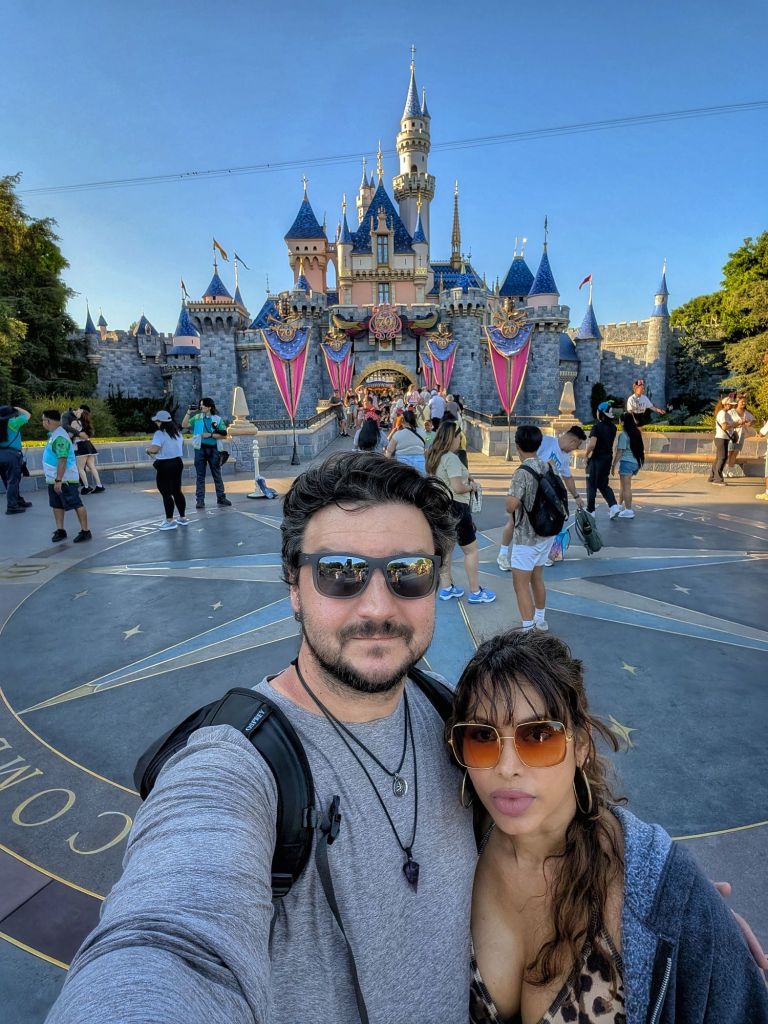
As Walt Disney once said, “Entertainment, such as that our business provides, has become a necessity, not a luxury.”
I trust you found this blog entry illuminating.
From your favorite conservative white guy in flip flops.
-JB
Also, I don’t do stuff for free anymore. My father owns a consulting business if you want to pay for anything additional, I’m sure he’d be happy to talk with you. I can always contract/freelance through him and his business if necessary, I suppose. I am currently under no contractual obligations with anyone or anything.
 Brunansky's Blog
Leave a comment