
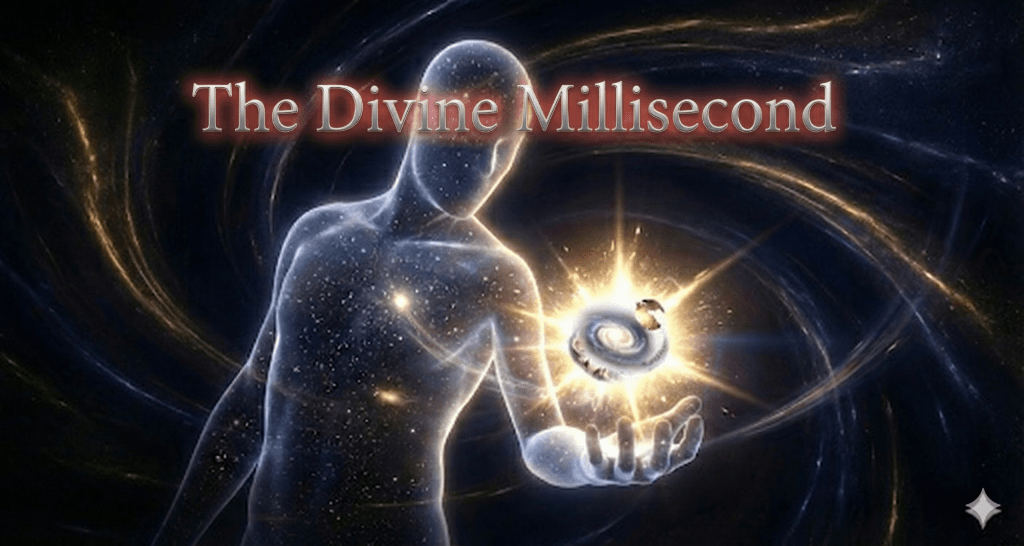
The Divine Millisecond: Reconciling the 1.4-Second Universe with the Eternal Observer
For centuries, the debate between science and religion has raged on. In one corner stands the science community, armed with carbon dating and tectonic maps, presenting a 4.5-billion-year-old Earth that drifts and evolves with slow, grinding indifference. In the other corner stands the religious community, clutching ancient texts that speak of a world summoned into existence by a voice, a flood that reshaped the globe, and a Creator who stands outside of time. The two sides seem irreconcilable. Lives have even been lost to this argument. One demands deep time; the other demands divine immediacy. One sees chaos organizing itself; the other sees a deliberate architecture.
However, this conflict may be a matter of perspective rather than fact. When we strip away the dogma of both religious literalism and scientific materialism, a startling convergence begins to emerge. If we accept the scientific reality of a universe born in a “Big Bang” and the theological premise of a God who exists outside of time, the contradictions dissolve. We are left with a unified theory of existence: a universe that is both billions of years old and, to its Observer, a singular, 1.4-second flash of artistic expression.
This essay argues that science and belief are not opposing forces, but rather different observational points of the same “Divine Millisecond.” An argument I have made for many years. Science continues to confirm the existence of religious stories. But now, we’ll examine it further in this blog post. I hope you have a drink at hand. We are about to dive right into the deep end. Let’s begin…

I. The Architecture of Order: Pangea and the Genesis of Form
The dialogue begins with the ground beneath our feet. Modern geology tells us that roughly 300 million years ago, the Earth’s landmasses were fused into a single supercontinent, Pangea, surrounded by a global super-ocean, Panthalassa. This massive island of order eventually rifted apart, drifting over eons to form the fragmented world we inhabit today.
Remarkably, the oldest creation narratives of humanity describe this exact configuration. The Hebrew book of Genesis, echoing even older Mesopotamian traditions like the Enuma Elish, describes the creative act not as the manufacturing of matter, but as the separation of order from chaos. “Let the waters under the heavens be gathered together into one place, and let the dry land appear” (Genesis 1:9). The ancient mind, innocent of plate tectonics, nevertheless grasped the fundamental truth: for land to exist in a chaotic universe, it must have once been unified—a fortress of “dry land” standing against the chaotic “deep.”
Critics often point to the geological impossibility of the biblical Flood breaking Pangea apart in human history. They are correct; the physics of such an event—friction generating enough heat to boil the oceans—would sterilize the planet. But this objection misses the deeper synchronization. The ancient writers were not recording a journalistic timeline of the Bronze Age; they were preserving a theological memory of the Earth’s structure. They correctly identified that the world began as a unity and moved toward diversity. The “breaking of the deep” is a poetic rendering of a geological reality. Science provides the mechanism (tectonics); religion provides the meaning (order vs. chaos). Both agree that the world we see is a fragmented remnant of a primal unity.
II. The Relativity of Genesis: The 1.4-Second Flash
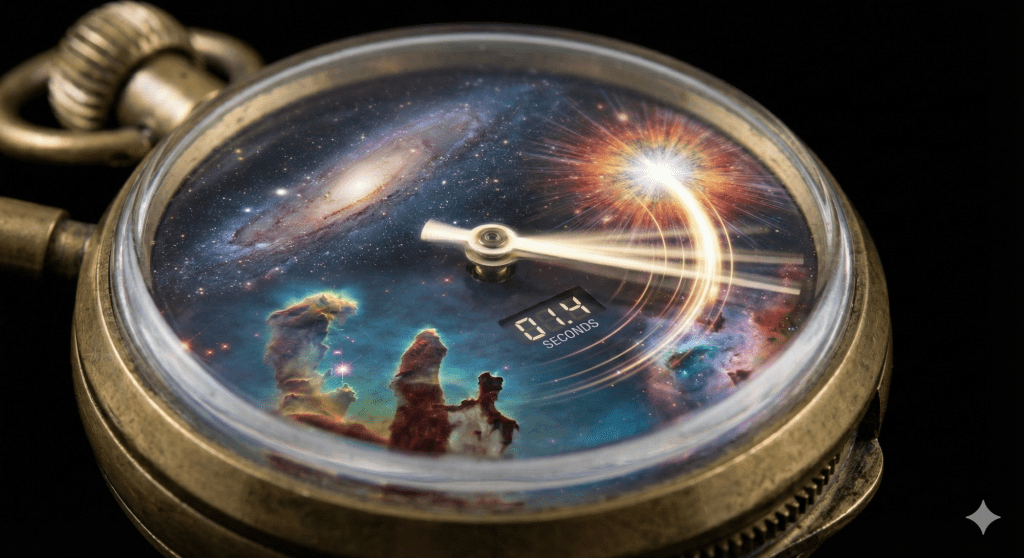
The most profound reconciliation, however, lies in the nature of time itself. The perceived conflict between a “Six Day Creation” and a “13.8 Billion Year Cosmos” is arguably a failure to apply the theory of General Relativity to theology. If God is an eternal being—defined not as living forever but as existing outside of time—then He does not experience duration. He is the Observer of the block universe, seeing the beginning and the end simultaneously.
The New Testament of the Christian Bible offers a specific mathematical ratio for this divine perspective: “With the Lord a day is like a thousand years” (2 Peter 3:8). If we apply this formula literally, the results are staggering. A “Creation Week” of seven human days, when viewed through the lens of this divine relativity, compresses into approximately 1.6 seconds. If we exclude the “Day of Rest,” the active construction of the cosmos—from the first burst of light to the appearance of Eve—takes place in roughly 1.4 seconds. When we overlay this “Divine Timeline” onto the “Scientific Timeline,” the synchronization is eerie.
* The First Second (Days 1–3): In physics, the “Inflationary Epoch” and the formation of matter happened in the first second of the Big Bang. In the biblical text, the foundations of the cosmos (Light, Skies, Land) are laid in the first three “days” (roughly 700 milliseconds). Both agree: the stage was built in a blink.
* The Great Pause (Day 4): Science tells us the universe went through a “Dark Age” before stars ignited and the atmosphere cleared. The text mirrors this, delaying the appearance of the Sun and Moon until “Day 4,” a massive leap in the narrative sequence that acknowledges the functional delay of starlight.
* The Explosion of Life (Day 5): The fossil record reveals the “Cambrian Explosion,” a sudden, inexplicable burst where complex life “swarmed” the oceans. The text matches this with the command for the waters to “teem with swarms” of living creatures.
* The Final Fraction (Day 6): Finally, in the last 236 milliseconds of this divine week, land animals rise, dinosaurs dominate and fall, mammals take over, and in the absolute final 0.28 milliseconds, humanity appears.
Under this model, the “contradiction” vanishes. The scientist studying the radiation of the Big Bang is measuring the mechanics of the event from the inside; the believer reading Genesis is reading the program notes of the Observer from the outside. The universe is not young or old; it is both, depending on where you stand relative to the speed of light.
If you need to pause now to take a drink or use the restroom, feel free. Ready to continue? Great… here we go!
III. The Observer and the Nano-Second Life
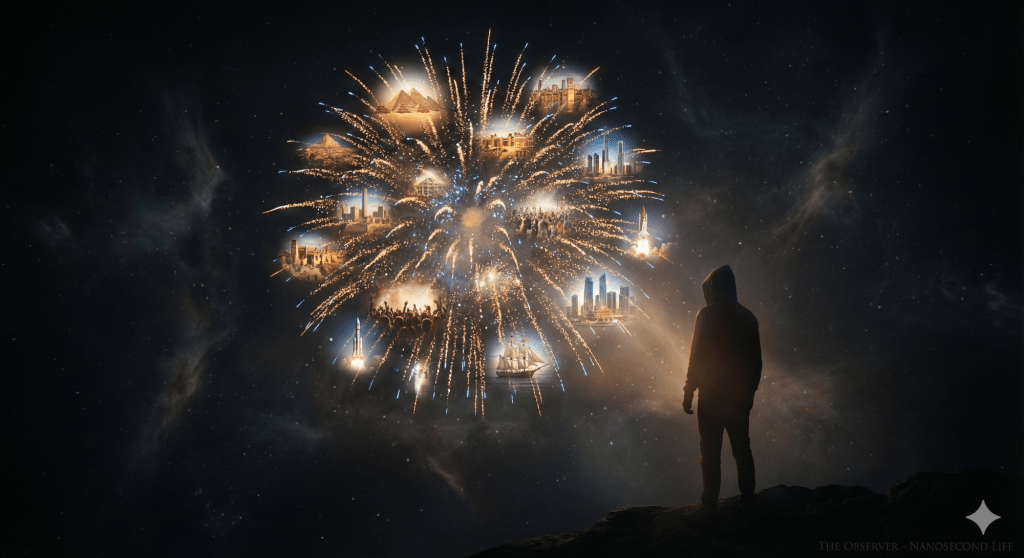
This model forces a radical theological shift. If the universe is a 1.4-second flash to the Creator, then the traditional concept of an “intervening” God must change. An Observer watching a firework explode does not have time to step in and rearrange the sparks before they fade. Similarly, a God operating at “hyper-speed” does not react to human events in linear time. By the time a prayer is formed on human lips, civilizations have already risen and fallen from the divine perspective.
This leads to a “Hyper-Speed Theology” where God is not the Director calling out cues, but the Audience witnessing a completed work. It reframes the human experience: we are not puppets on a string, but the energy generated by the reaction. Our lives, lasting a mere fraction of a divine nanosecond, are fleeting sparks. This perspective risks nihilism—how can a nanosecond life matter?—but it actually elevates the human condition. If the Observer is focusing on the flash, then the quality of the light matters. We are not “subjects” to be ruled; we are the signal being transmitted.
IV. The Signal in the Static: Prayer as Energy Projection
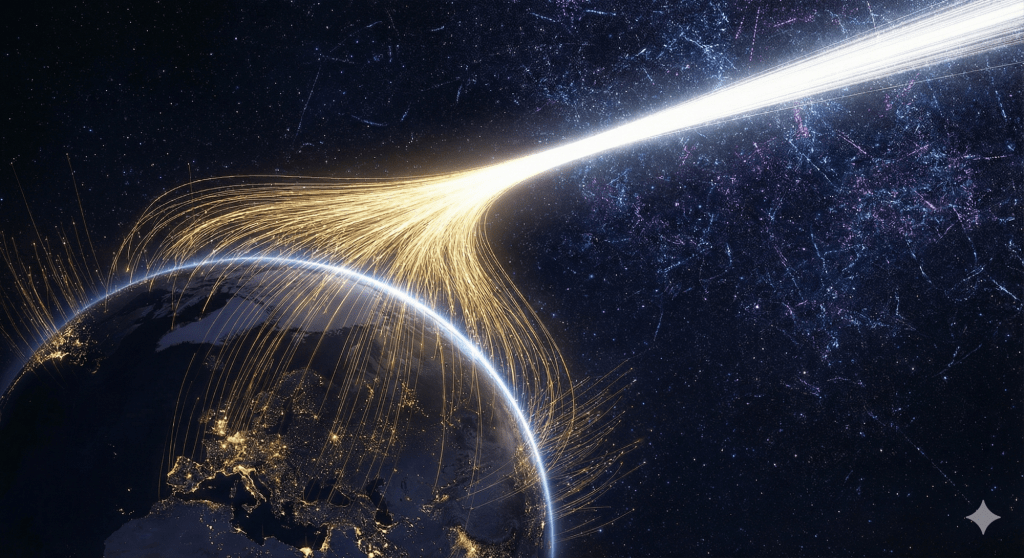
If God is the Observer of a finished, flashing universe, how does the inhabitant of the nanosecond communicate with Him? This brings us to the universal human practice of prayer, meditation, and manifestation. Across all cultures—from the Jewish Kavanah to Buddhist Mantra and secular Manifestation—the mechanism is identical: the generation of reality-altering power through focused, repetitive, synchronized intent.
Scientific anomalies like the Global Consciousness Project provide a tantalizing hint that this is not merely superstition. When billions of minds synchronize their focus (as seen during 9/11 or global celebrations), random number generators deviate from the norm. We create order from entropy. We “manifest.”
In the context of the 1.4-second universe, this makes perfect sense. A random thought is noise, lost in the roar of the Big Bang. But a focused, synchronized intention creates a standing wave—a signal bright enough to be seen by the Observer. Prayer is not a request for a favor; it is an “upload.” It is the method by which the microscopic consciousness (human) signals the macroscopic consciousness (God). By unifying our intent, we increase the signal-to-noise ratio of our existence, ensuring that our specific spark catches the eye of the Observer.
Ok, if you need to stand up and stretch, go for it. We’re about to sink deeper still into this topic. Ready? Fantastic… here we go!

V. Retro-Causality: The Editor of the Timeline
The final piece of this synthesis addresses the problem of miracles. If the universe is a finished block, and God is too “fast” to intervene, can reality be changed? Both quantum physics and Molinist theology answer “Yes,” but not in the way we expect. They suggest that the “adjustment” happens outside of time.
The Delayed Choice Quantum Eraser experiment in physics has demonstrated that an observation made in the future can determine the state of a particle in the past. Time is not a one-way street. Similarly, the theology of “Middle Knowledge” suggests that God knows all possible timelines and “instantiates” (makes real) the one that aligns with His will and our free choices.
This implies a form of “Retro-Causal Faith.” When a person prays for a miracle, they are not asking God to stop the car crash now; they are sending a signal from the future (gratitude/faith) that travels backward up the timeline. The Observer, seeing the entire 1.4-second flash at once, sees the signal and “edits” the timeline at the moment of creation to ensure the outcome that leads to that signal. The miracle is not a reaction; it is a pre-loaded feature of the specific timeline selected by the Observer. We are the co-authors of the script, casting our votes for which version of the movie gets played.

Conclusion
We live in a time where we are told we must choose. We are told to choose between the cold, godless vastness of the cosmos and the warm, irrational comfort of faith. We are told that Pangea proves Genesis wrong, or that the Big Bang disproves the Creator.
But this essay argues that the choice is false. When we look at the data—the geological unity of the past, the relativity of time, the quantum mechanics of observation, and the universal instinct for prayer—we see a single, coherent picture. We see a universe that is a masterpiece of order, exploding into existence in a 1.4-second flash of divine creativity.
We see an Observer who is both infinitely far (outside time) and intimately near (conscious of every nanosecond). And we see ourselves not as accidents of chemistry, but as the consciousness of the cosmos, capable of shaping the light of the flash through the power of our belief.
To believe in science is to admire the mechanism of the flash. To believe in God is to admire the Observer of the flash. Wisdom is the realization that the mechanism exists for the Observer, and that we are the connection between the two.
Take a drink. Take a stretch. Take a walk. You’ve earned it. And when you’re done, come back and leave a comment and probably subscribe for future entries.
Your favorite conservative white guy in flip flops,
–JB
 Brunansky's Blog
Leave a comment