

I have been devouring AI content. It could be training and certifications, philosophy, leadership and application, or just high-level articles covering the current business landscape of AI in modern business. After this ravenous approach to understanding the opportunities and strategies within this new business model, I have discovered something shocking: leadership tactics from the late 18th century and early 19th century Industrial Revolution. I had to ask myself, “How does a leadership style before computers offer any value to an age where computers are now the labor workforce?” The answer surprised me, but it should not have. So, let’s dive into this topic with the eyes of someone who used methods being discussed now almost twenty years ago with his project workforce. This was before the age of AI, Work-From-Home (WFH), and before terms like “work/life balance” were part of the popular zeitgeist.
The Architect of the Archaic: The Industrial Shadow
The contemporary corporate landscape is currently snagged on a profound ideological thorn. While our tools have propelled productivity into a “lossless” era of rapid iteration, the frameworks used to manage the humans behind those tools remain stubbornly anchored in the nineteenth century. We are witnessing a collision between the “vibe coding” future and the coal-powered past. As modern business leaders debate the merits of remote work and “token-based” performance metrics, they are essentially arguing over how best to dress a Victorian ghost in a digital suit.
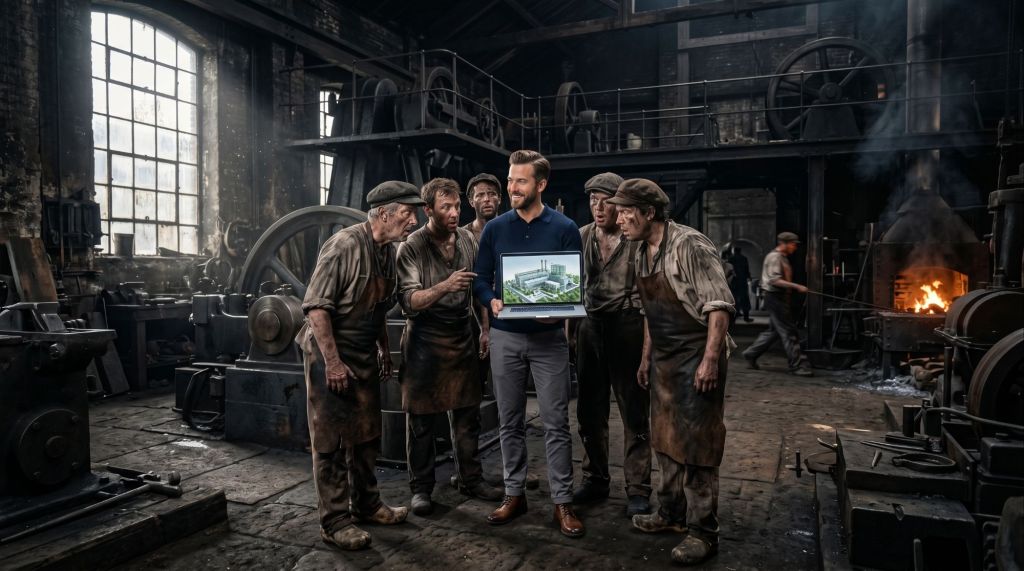
The roots of this management style are not digital; they are mechanical. During the Industrial Revolution, the factory floor necessitated a specific type of oversight. Productivity was tethered to physical presence and the rhythmic output of machines. Because human labor was seen as an extension of the steam engine, management became the art of monitoring “time and motion.” Success was measured by the hour, the quota, and the visible exertion of the worker. This birthed the “Forty-Hour Work Week” and the “Steady Rate” myth—the belief that a professional’s value is a linear function of their time spent at a desk.
The Token Trap: Surveillance in a New Hat
Fast forward to 2026, and this industrial ghost has found a new metric to haunt: AI token usage. As organizations integrate Large Language Models (LLMs) into their daily operations, a disturbing trend has emerged where leaders analyze token consumption as a Key Performance Indicator (KPI). The logic is deceptively simple and dangerously flawed: if an employee is “burning” more tokens, they must be working harder.
This is the industrial-era “shovels of coal” mentality rebranded for the silicon age. Measuring performance by token count is the ultimate “lazy metric.” It ignores the reality of elite digital craftsmanship. A sophisticated architect of AI can achieve a superior result with a single, highly refined prompt that consumes minimal tokens. Conversely, an inefficient or “noisy” worker might cycle through thousands of tokens, generating “AI slop” through circular, poorly directed queries. By prioritizing token volume, management inadvertently incentivizes incompetence and punishes the very efficiency that AI was designed to provide.
The Paradigm Shift: Lossless Productivity and the Autonomy Loop
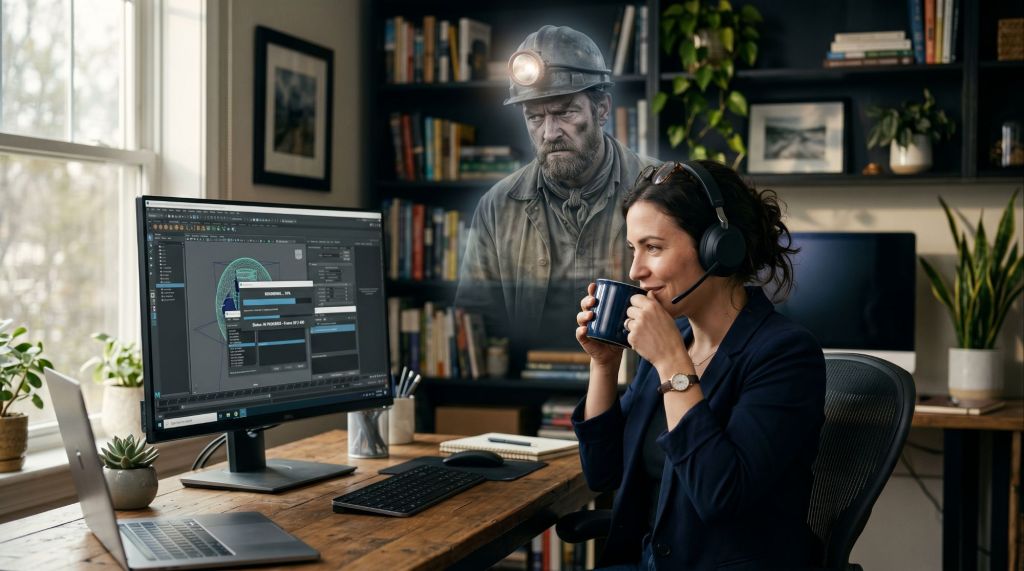
The true promise of the modern workforce lies in its “lossless” nature. We are now capable of publishing websites in minutes and rendering complex applications in hours—processes that once took weeks of manual labor. This shift has decoupled the traditional relationship between effort and output. In an AI-augmented environment, the “work” is no longer the manual construction; it is the orchestration, the vision, and the final sign-off.
Twenty years ago, when I led project management teams, I practiced a proto-version of this “Results-Oriented” environment. If my staff completed their work to a high standard of satisfactory competence, they could leave. If they had family obligations or simply finished early, they were free. Other managers questioned why my team was leaving the office, to which the answer was always the same: The work is done. This created an incredible loop of loyalty and productivity. The team knew that flexibility was the reward for excellence, but they also knew that if the quality wasn’t there, they stayed until it was.
The Resolution: Managing the Vision, Not the Clock
In the digital era, “Deep Work” requires periods of cognitive decompression. The ability to run three or four projects simultaneously via AI agents and then “step away” for a “mental render” is not a lapse in productivity—it is a functional necessity for maintaining high-level strategic oversight. The “rest” is part of the “work.”
Professional leadership in the age of AI must be about curation rather than surveillance. We must stop asking “How much did you do?” and start asking “What did you achieve?” If the final product is excellent, the specific path taken to reach it—whether it took two hours or twenty, or consumed ten tokens or ten thousand—is irrelevant to the bottom line.
The transition from a coal-powered leadership style to a digital-led strategy requires a fundamental trust in human judgment. We are moving into a post-activity era where the human’s role is to provide the “vibe,” the ethics, and the final approval. The industrial revolution gave us the tools to build a world; the AI revolution gives us the tools to refine it. Leadership must now catch up and realize that in a lossless world, the only thing that cannot be automated is the wisdom to know when the work is finally “done.”

Author Jeremy Brunansky is a leader with over 20 years of experience. He has led individuals, teams, departments, sites, and projects. His background extends through sales, customer service, project management, and operations. He holds certifications from Google and Hubspot for AI in the modern workforce and is currently finishing a certification in AI with Microsoft. His methods may not always be traditional, but they produce the required results.
 Brunansky's Blog
Leave a comment